Meeting with the Swedish Ministry of Justice.
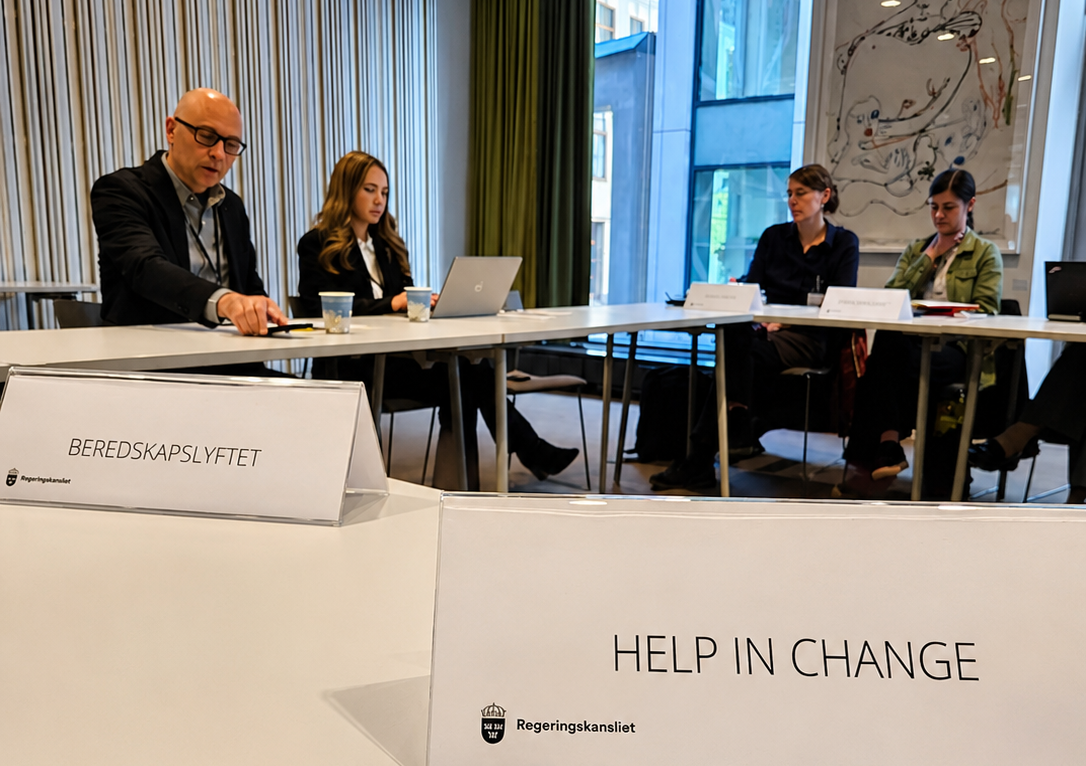
On May 7, 2026, Help in Change was invited to take part in a dialogue with the Swedish Ministry of Justice, represented by Johan Malkan, together with several civil society organizations working within migration, asylum, human rights, legal support and integration.
The meeting was focused on the current situation in the field of migration and the practical experiences of organizations that meet people affected by migration policy in their everyday work.
Before the meeting, the participating organizations were asked to answer three questions:
- What do we see as the most important development or challenge in our work within the field of migration right now?
- What issues are most frequently raised by the people we meet?
- What is the most important message we want the Ministry of Justice to take with them from our practical work?
For us, at Help in Change, it was important that our answers would not only reflect our own organizational perspective. We wanted to bring the voices of Ukrainians in Sweden directly into the room.
That is why, before the meeting, we reached out to our Ukrainian followers and community members who are currently in Sweden because of Russia’s full-scale invasion of Ukraine. Their answers were collected and presented during the meeting by our Chairwoman and co-founder, Ira Sjölund.
Shared concerns from civil society
During the roundtable discussion, many organizations raised similar concerns.
Among the participating organizations were the Swedish Church, the Swedish Red Cross, the International Rescue Committee, the Swedish Bar Association, the Swedish Muslim Federation, RFSL Ungdom, RFSL, the Swedish Christian Council, Civil Rights Defenders, UNHCR, Asylrättscentrum, Beredskapslyftet and Stadsmissionen.
Across the room, one concern was repeated again and again: UNCERTAINTY.
Organizations described the rapid pace of legal and political changes, the lack of predictability, long processing times, administrative barriers and the growing difficulty of giving people clear and reliable guidance. Several organizations also emphasized how this uncertainty affects people’s mental health, their motivation to integrate and their ability to plan their lives in Sweden.
Many also pointed out that when rules change quickly, it does not only affect the individuals seeking protection or residence. It also affects the people and organizations trying to support them.
Statement by Ira Sjölund, Chairperson and co-founder of Help in Change
Hello, and thank you very much for allowing me to be here today.
My name is Ira Sjölund. I am the Chairperson and co-founder of Help in Change, a non-profit organization that was founded in March 2022, shortly after Russia’s full-scale invasion of Ukraine. We began as a network of volunteers helping Ukrainians with information, practical support and guidance. Today, we work long-term with integration, civic information, education and advocacy.
Over the past years, we have met thousands of Ukrainians in Sweden, helped them understand the Swedish system and lifted their voices in meetings with authorities and decision-makers.
Let me move on to the three questions you wanted us to answer.
1. What do we see as the most important development or challenge right now?
I would like to begin by thanking the Swedish government for actually listening to several of the problems we raised last year in the meeting with the Minister for Migration.
The development that has taken place is that from June 11, 2026, people with temporary protection will, in certain cases, be able to apply for other residence permits directly from Sweden, for example work permits, research and higher education. This is an important change that shows that the problems we raised were real and necessary to address. Thank you again.
But this development does not solve the whole problem, but rather creates other challenges for Ukrainians. This law mainly helps people with a sufficiently high salary, the right employer or the right educational background. A large number of Ukrainians who are already established in Sweden still fall outside.
Many have now lived here for four years. In 2027, for them, it may be five years of work, tax payments, language learning, children’s schooling and integration. But legally, these years are still treated as temporary.
One person wrote to us:
How can they not count the four years we have been in Sweden? In 2027 it will be five years. Five years of our lives. We are not invisible.
People feel that the system is saying: you have worked, you have paid taxes, your children go to Swedish school, but your future here is still uncertain.
2. What comes up most often in our contact with the people we meet?
What comes up most often is the question:
Do I have a future here?
One Ukrainian woman wrote to us that she has worked the whole time in Sweden in the social sector, paid taxes, studied Swedish, obtained a Swedish driving licence and is currently living in northern Sweden, where there is a labour shortage. Her question is simple but painful:
Do I have a real chance to become part of this society? Or will I just be thrown out?
We meet women with children, young adults who came here as children but have now turned 18 or older, and pensioners. Many want to contribute, but the requirements do not match reality.
From June 1, 2026, the general requirement for a work permit is a salary of SEK 33,390 before tax.
I want to tell you: my partner is a Swedish citizen and earns around SEK 30,000 before tax. If a Swedish citizen working full-time is below the level required for a work permit, how realistic is it then to require a newly arrived Ukrainian, most often a woman starting from zero in a new country, to quickly reach that salary level in order to gain security? And what are young Ukrainians and pensioners supposed to do in that case?
According to Statistics Sweden, 41,970 Ukrainian citizens were registered as living in Sweden on December 31, 2025. Based on Eurostat’s average gender and age distribution among people with temporary protection from Ukraine in the EU, this corresponds to approximately 18,000–19,000 adult women and around 13,000 children under the age of 18 in Sweden.
At the same time, IOM’s survey shows that labour market activity among Ukrainians in Sweden is high: 85 percent of the women in the survey were either employed or looking for work, and 66 percent of the respondents were employed.
The Swedish Migration Agency also assesses that many people with temporary protection who are working have incomes below the new income requirements. This means that Sweden risks excluding people who already work, pay taxes and contribute, especially women with children, young adults and people in socially important but lower-paid professions.
The signal many people experience is:
You are welcome to work, pay taxes and take the jobs society needs, but your work may still not be enough for you to be allowed to stay.
3. What do we want the Ministry of Justice to take with them?
The most important thing we want you to take with you is this:
Many Ukrainians in Sweden are no longer just a temporary protection group in practice. They are colleagues, parents, students, taxpayers, care workers, entrepreneurs and students. But the system still treats them as if their lives here are only in a waiting position.
We understand that the government and the Tidö parties have a strong focus on return policy and that Sweden needs clear rules. But what happens to human rights, the best interests of the child and basic human dignity in this process?
What happens to young people who came here as children, went to Swedish school and are now expected to meet the same requirements as established workers? What happens to pensioners who cannot work their way into a work permit? Especially when unemployment is so high that even I cannot find a job.
What happens to people from occupied territories where returning could mean danger or torture? There must be more reasonable requirements and a more realistic way forward.
Therefore, we want to leave three messages:
First: time in Sweden must mean something. Four or five years of work and integration cannot be treated as if they did not happen.
Second: there must be a reasonable path also for those who do not meet high salary requirements — especially young adults, pensioners and people in socially important but low-paid professions.
Third: Sweden needs a clear long-term solution before 2027. Not at the last minute, when people are already living in panic and uncertainty.
We thank Sweden for the protection that has been given to Ukrainians and for the changes that have now been decided. But we ask you not to stop halfway. Because behind every legal category there is a human being.
Thank you.
Help in Change will continue to carry these voices forward
Help in Change is grateful for the opportunity to participate in this dialogue with the Ministry of Justice and other civil society organizations.
At the same time, we want to be clear: dialogue with ministry officials can be important, but it cannot replace direct dialogue with the Minister for Migration. The experiences of civil society and the voices of people directly affected by migration policy must continue to reach the political level.
We will continue to listen, collect testimonies, document the situation and bring the voices of Ukrainians in Sweden into the rooms where decisions are made.


